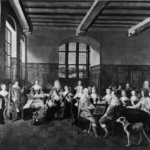
 Program Notes: The Family Band
The Family Band connects the 17th and 21st centuries through the timeless theme of family relationships. We explore the role that music played in one 17th century family’s learning from and caring for each other through a program featuring music that they composed together.
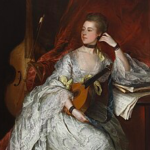 Program Notes: Escape to the Stage
When British socialite Ann Ford’s father demanded that she marry a man 30-years her senior (who had attempted to pay for her hand in marriage), she was desperate to find a way out. With money she borrowed from her well-to-do friends, Ann rented out some of London’s most prestigious concert venues and launched a concert series to fund her own independence.
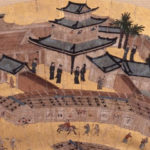 Early Music America article on Musicians of the Tenshō Embassy
“Four Japanese boys, students at a Jesuit school, were sent on an eight-year tour of Europe. This little-known story is as complicated as it is fascinating. Lyracle, a Boston voice-and-viol ensemble, programmed music associated with the Tenshō Embassy. But tracing this fraught history meant accepting a host of practical, historical, and ethical challenges…”
Program Notes: Lady Tarquinia
Lady Tarquinia celebrates the musicianship that Tarquinia Molza (1542-1617) cultivated her whole life, even after rumors of an affair crushed her glittering career as a court musician.
 Program Notes: At Home in Sweden
In “At Home in Sweden,” we explore how music from 17th-century Europe’s courts, theatres, churches, and street corners all made its way into the very same pages where it delighted communities of friends and family in Sweden’s living rooms.
Program Notes: Musicians of the Tenshō Embassy
In 1582, four teenage Japanese boys of noble birth set sail from Nagasaki to Lisbon. They were students at the Jesuit school in Kyushu and were sent on a tour of Italy and Iberia as ambassadors of three Japanese daiymo, or feudal lords, who had converted to Christianity. They were known collectively as the Tenshō Embassy. Discover the amazing story of the 1582 Tenshō Embassy and their musical journey from Japan to Europe and back!
 Program Notes: Exodus and Evolution
A multigenerational family of Jewish musicians, the Lupo’s exodus from Iberia, migration to Northern Italy, and recruitment to England coincided with key developments in the evolution of the viol and the flourishing of its associated repertoire.
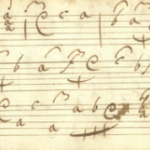 Program Notes: In Sweetest Sympathy
In Sweetest Sympathy showcases the lyra viol, complete with sympathetic strings. We explore vocal and instrumental repertoire for this fabulous instrument and its relationship to different contexts of 17th century music making within and beyond England.
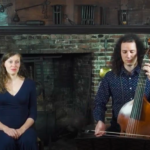
We explore the musical lives of known viol players in colonial MA, from amateur players, reverends, and teachers to women unnamed in historical records.
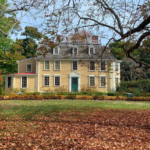
In the “Old Kitchen” of the Quincy Homestead, still preserved from its original 1680’s construction, we explore at-home music making in colonial Massachusetts through a historic lens.
We celebrate the talents and accomplishments of Tarqunia Molza (1542-1617), the virtuosic soprano, viol player, and highly paid employee at the Este Court in Ferrara, who was known for her unrivaled ability to accompany her own singing on the viol.
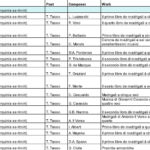
We hope you’ll help us keep Molza’s legacy alive by exploring our new catalogue of such madrigals, complete with basic information, where to locate each piece, and a few English translations.
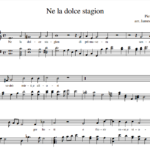
We celebrate the talents and accomplishments of Tarqunia Molza (1542-1617), the virtuosic soprano, viol player, and highly paid employee at the Este Court in Ferrara, who was known for her unrivaled ability to accompany her own singing on the viol.
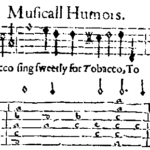
We trace the documented history of the practice of accompanying a solo voice with a single viol from Italy with the 1543 publication of Silvestro Ganassi’s Regola Rubertina, to England, where the practice enjoyed its 17th century heyday.